
When you have Cancer (A New Normal)
A Survivor’s Journal · January 2025
The life you return to is not the life you left.
Cancer may end, retreat, or become manageable, but the person who emerges is rarely unchanged. Survival creates its own landscape, one in which gratitude, fear, love, uncertainty, and hope must learn to live beside one another.
There is the life before cancer, and the life after knowing.
Before cancer, mortality can remain an idea at the edge of consciousness. After cancer, it may sit quietly in the room.
Diagnosis changes more than a medical chart. It changes the architecture of ordinary life. Plans that once felt solid may become provisional. A routine appointment can carry the emotional weight of a verdict. A new ache may awaken an old fear.
Even after treatment, the mind may continue listening for danger. The body may recover faster than trust. Friends may celebrate the return to normal while the survivor quietly understands that the old normal no longer exists.
This does not mean life becomes smaller. It means life becomes sharper. Time feels more visible. Love feels more urgent. Ordinary moments acquire a strange brightness because their impermanence can no longer be comfortably ignored.
 A Prayer Without Words
Oil on canvas · 30 × 40 inches
View artwork
A Prayer Without Words
Oil on canvas · 30 × 40 inches
View artwork
Some days, continuing is the only prayer available.
During illness, strength does not always look brave. It may look like getting dressed for another appointment, sitting through another infusion, answering another phone call, or finding enough energy to reassure someone else.
There are moments when language fails completely. Fear, exhaustion, responsibility, love, and uncertainty gather inside the same body without arranging themselves into a sentence.
A Prayer Without Words holds that suspended space. The upward face is neither a performance of defeat nor a declaration of victory. It carries the private courage of remaining present when control has disappeared.
That quiet persistence is part of the new normal. Survival is not always triumphant. Sometimes it is simply the decision to remain.
Explore A Prayer Without WordsThe world looks familiar, but it no longer means the same thing.
The transformation may be invisible to everyone except the person living inside it.
Work resumes. Groceries are purchased. Emails are answered. Birthdays return. Yet beneath the ordinary rhythm is a new awareness of the body, of time, and of how quickly certainty can dissolve.
Tomorrow no longer feels guaranteed
Plans still matter, but they may be held with greater humility. The future becomes something hoped for rather than assumed.
The familiar becomes uncertain
Scars, fatigue, changed strength, medical surveillance, and fear can alter the relationship between a person and their own body.
Care becomes more urgent
The possibility of absence may intensify the desire to protect, prepare, forgive, speak honestly, and remain close.
The old self does not simply return
Survivorship asks a person to build an identity spacious enough to contain who they were and what they have endured.
 Profile in Crimson
Oil on canvas · 30 × 22 inches
View artwork
Profile in Crimson
Oil on canvas · 30 × 22 inches
View artwork
Profile in Crimson
Learning to recognize the person who survived.
Cancer can make the self feel divided into versions: the person before diagnosis, the patient inside treatment, and the survivor trying to understand what remains.
Profile in Crimson enters that private territory of identity, presence, and self-recognition. Crimson becomes more than color. It suggests life, injury, defiance, vulnerability, and the heat of a person refusing to disappear inside a diagnosis.
Built through layers of black, umber, ivory, rust, mineral blue, and deep crimson, the figure seems to emerge from darkness and memory. The portrait remains partly unresolved, reflecting the truth that identity after illness is rarely restored in one clean gesture.
The new normal begins partly through this act of recognition: looking at the changed self without turning away.
View Profile in CrimsonSometimes fear is not about leaving. It is about whom we might leave behind.
Illness can expose the protective instinct at the heart of love. When the future becomes uncertain, the mind may begin arranging, planning, preparing, and trying to care beyond every possible outcome.
I Will Always Be There was born from that emotional space: the desire to remain beside another person even when physical presence can no longer be promised.
The bowed figure and the distant presence are separated, but the distance is not abandonment. It is a corridor of guardianship, devotion, and the belief that care can continue beyond what the eye can see.
Cancer changes love by revealing its depth. It shows how much of love is built from promises we hope never need to be tested.
Explore I Will Always Be There I Will Always Be There
Oil on canvas · 30 × 25 inches
View artwork
I Will Always Be There
Oil on canvas · 30 × 25 inches
View artwork
Survival is not a return ticket.
The phrase “new normal” can sound tidy, but the life it describes is rarely orderly.
The new normal may hold gratitude and anger in the same hour. It may contain relief, exhaustion, fear, tenderness, grief, and an almost painful appreciation for ordinary life.
Survivors are often expected to emerge grateful, positive, and ready to move on. Gratitude may be real, but it does not cancel what happened.
Healing requires room for contradiction. A person can be thankful to be alive and still mourn the life, body, confidence, or sense of safety they once possessed.
The work is not to force life back into its former shape. The work is to build a life honest enough to contain the whole story.
You do not have to perform recovery for anyone.
There is no correct emotional costume for surviving cancer.
The experience may make someone more joyful, more cautious, more spiritual, more restless, more protective, or simply tired. None of these responses cancels survival.
The old normal was built on certainty. The new normal is built on presence.
Survival does not promise that fear will disappear. It offers the possibility of living with greater honesty inside the time that remains.
Three works shaped by illness, devotion, silence, and survival.
Each painting approaches the new normal from a different emotional doorway.
One confronts the changed self. One holds the prayer that cannot be spoken. One carries love across the possibility of absence.
 The Changed Self
Profile in Crimson
Identity, visibility, and the courage to recognize who remains.
The Changed Self
Profile in Crimson
Identity, visibility, and the courage to recognize who remains.
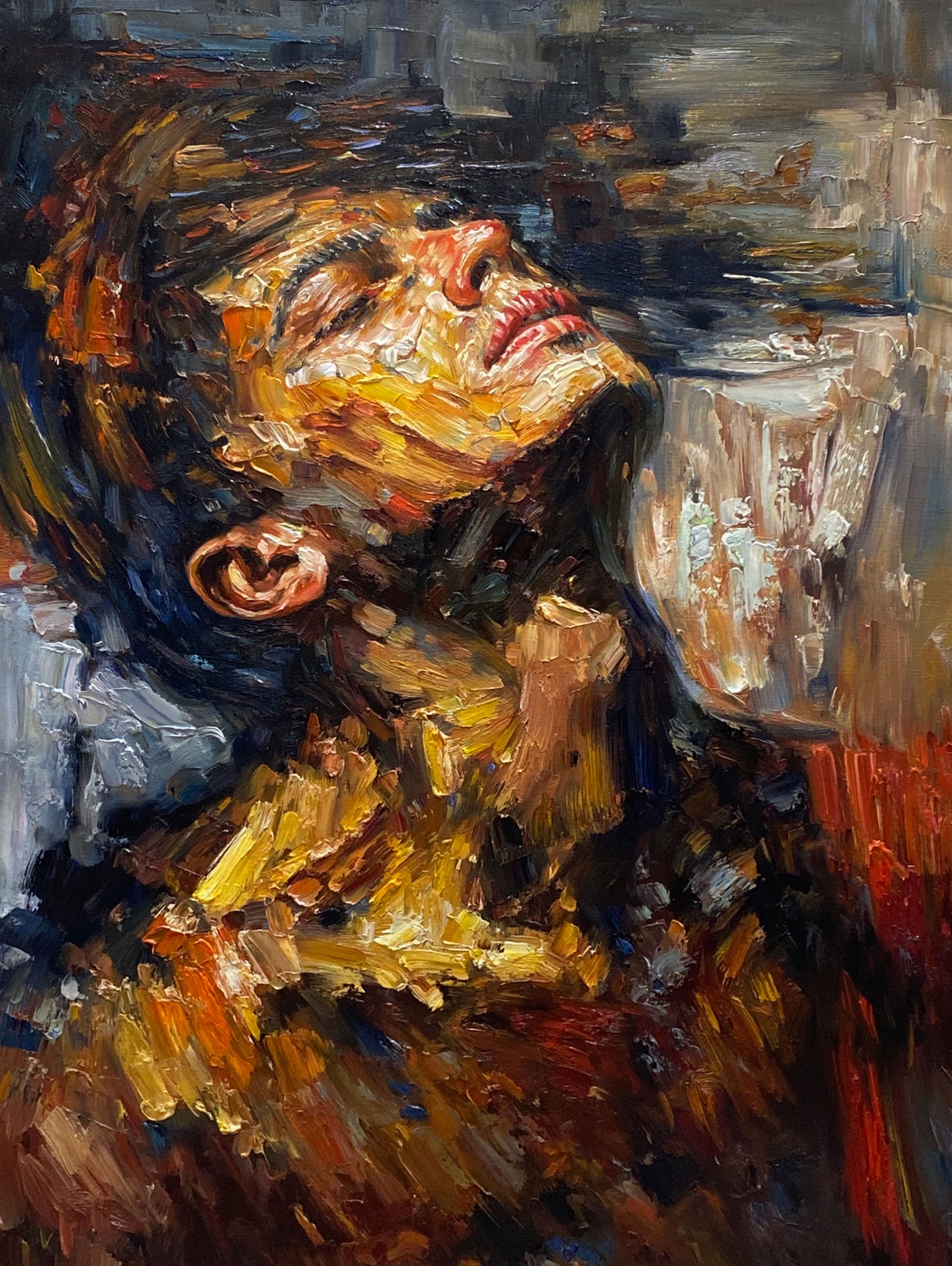 The Unspoken Prayer
A Prayer Without Words
Quiet endurance when language, certainty, and control fall away.
The Unspoken Prayer
A Prayer Without Words
Quiet endurance when language, certainty, and control fall away.
 The Enduring Promise
I Will Always Be There
Love transformed into protection, guardianship, and continuity.
The Enduring Promise
I Will Always Be There
Love transformed into protection, guardianship, and continuity.
Survival demanded meaning.
When life did not return to what it had been, the question became: what should be done with the time that remained?
The Mabazza Foundation grew from the understanding that people facing illness need more than treatment. They need beauty, emotional recognition, dignity, support, and reminders that they remain part of the human world beyond the diagnosis.
Art became a way to give form to experiences that often remain invisible. A painting can witness fear without demanding an explanation. It can sit beside grief without rushing it. It can remind a survivor, caregiver, patient, veteran, or isolated elder that someone has considered what they may be carrying.
The new normal became more than an aftermath. It became the ground from which a mission could grow.
Living after the dividing line
Survival is not the restoration of the old life. It is the beginning of another.
The person who survives may carry scars, fear, gratitude, anger, tenderness, and a clearer awareness of time. These are not signs that recovery has failed. They are evidence that something profound was lived through.
A new normal does not ask us to forget what happened. It asks us to create a life capable of holding it.
That life may be more fragile than the one before it, but it may also be more deliberate, compassionate, awake, and honest.
Life is different now.
Different does not mean diminished.
Different can still become beautiful.